Turbot GuardianPreview

Guardrails for
Vibe Coding

Your developers and shadow IT are using AI coding agents every day. Guardian gives your security team visibility and control over every credential those agents hold, plus the resources and environments they can reach, across every machine in your fleet.

You locked down your CI/CD pipeline. You hardened your cloud IAM. But your developers' AI agents have the keys to everything, and nobody's watching.


Talk to us →
Guardian Fleet Overview Dashboard
40+
Credential formats discovered
42
Session threat paths detected
<1s
Policy evaluation time
5
Enforcement modes
Guardian Dashboard showing live sessions and recent blocks

AI agents don't ask permission.

AI coding agents run with full developer permissions. They can read AWS keys, database passwords, and API tokens. A single unmonitored session can exfiltrate secrets, make unauthorized API calls, or expose production credentials. And there's no audit trail.

See every credential on every developer machine
Know which AI agents are installed and active
Watch what agents do with credentials in real time
Block credential exfiltration before it happens

Works with the agents your team already uses

Claude CodeClaude Code
CursorCursor
GitHub CopilotGitHub Copilot
Aider
Gemini CodeGemini Code
CodexCodex

Full visibility and control over your AI agents

What agents are running?

Guardian auto-discovers every AI coding agent across your fleet, including Claude Code, Cursor, Copilot, Aider, Gemini, and Codex. It maps the devices they run on and the MCP servers and plugins they connect to.

What can they reach?

See the blast radius of every agent. Guardian inventories the credentials each one can use, then maps them to the projects, resources, and environments those credentials unlock.

What are they doing?

Watch agents live, or replay any session after the fact. Guardian stitches every prompt, tool call, and credential use into one timeline, and raises a threat when a session matches a known attack pattern.

How do you control it?

Set the rules and enforce them. Guardian parses each command down to the Bash, Python, and SQL to see the credential, resource, and operation in play. Block risky actions, warn on others, and allow the rest.

How does it deploy?

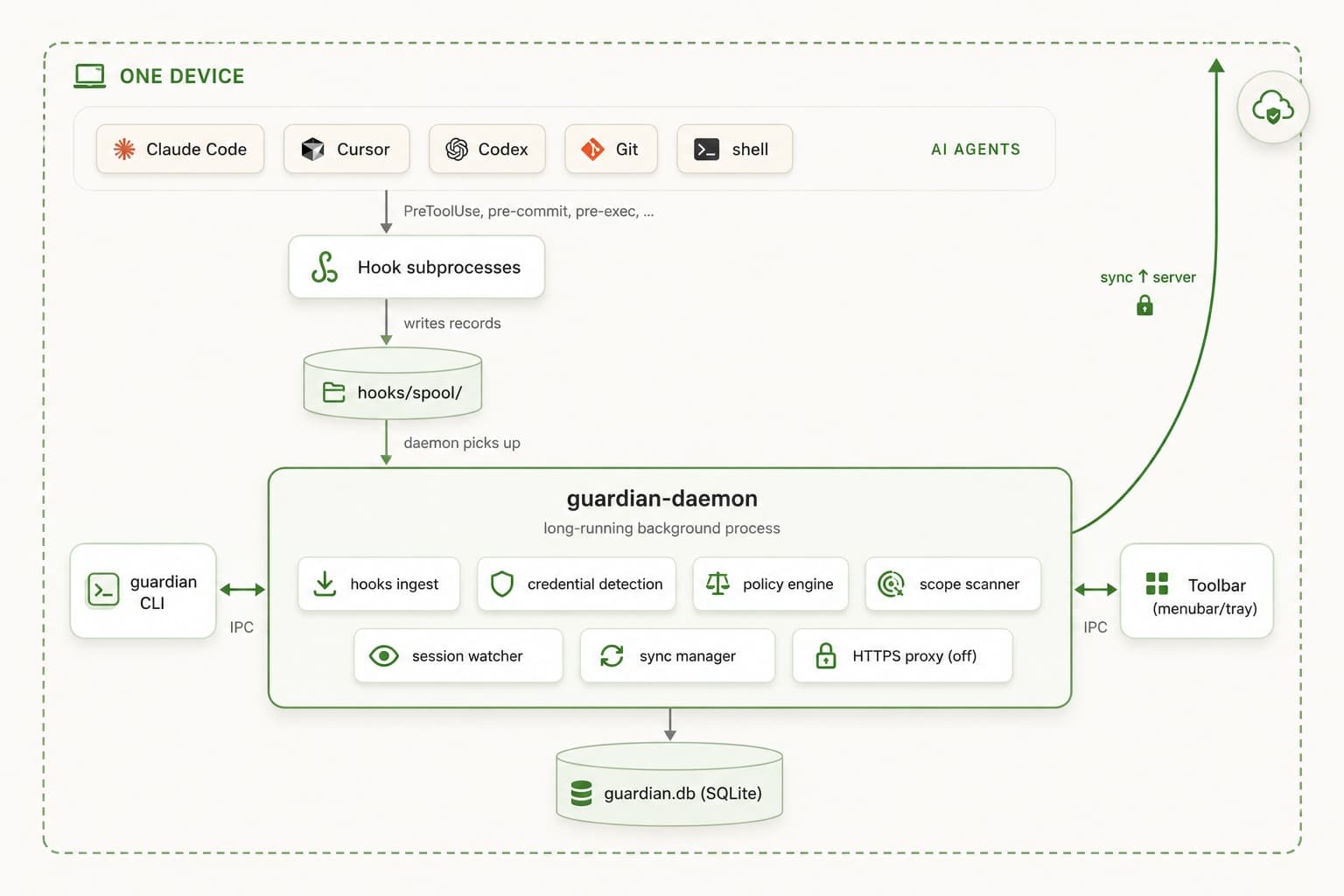
In minutes, not months. Guardian runs as native hooks in each agent's own config: no proxy, no sandbox, no code changes. A lightweight daemon enforces your rules in milliseconds, even offline.

What is AI costing you?

Break down agent spend by project, model, and developer. When your team juggles several projects at once, you can finally see where the AI budget actually goes.

Most tools stop at the prompt.
Guardian parses the command.

Guardian deconstructs every command, tool call, and script about to run, down to the Bash, the Python, and the SQL: which credential is in play, which resource is being touched, whether the operation reads or writes, and whether the target is production. So a single rule can let an agent read freely, warn on a write to development, and block that same write to production.

Diagram deconstructing a psql UPDATE command into a write operation, the postgres payments_production resource, and the database credential, then denying the write on production while allowing it on the scratch database

Inside the agent,
across the fleet.

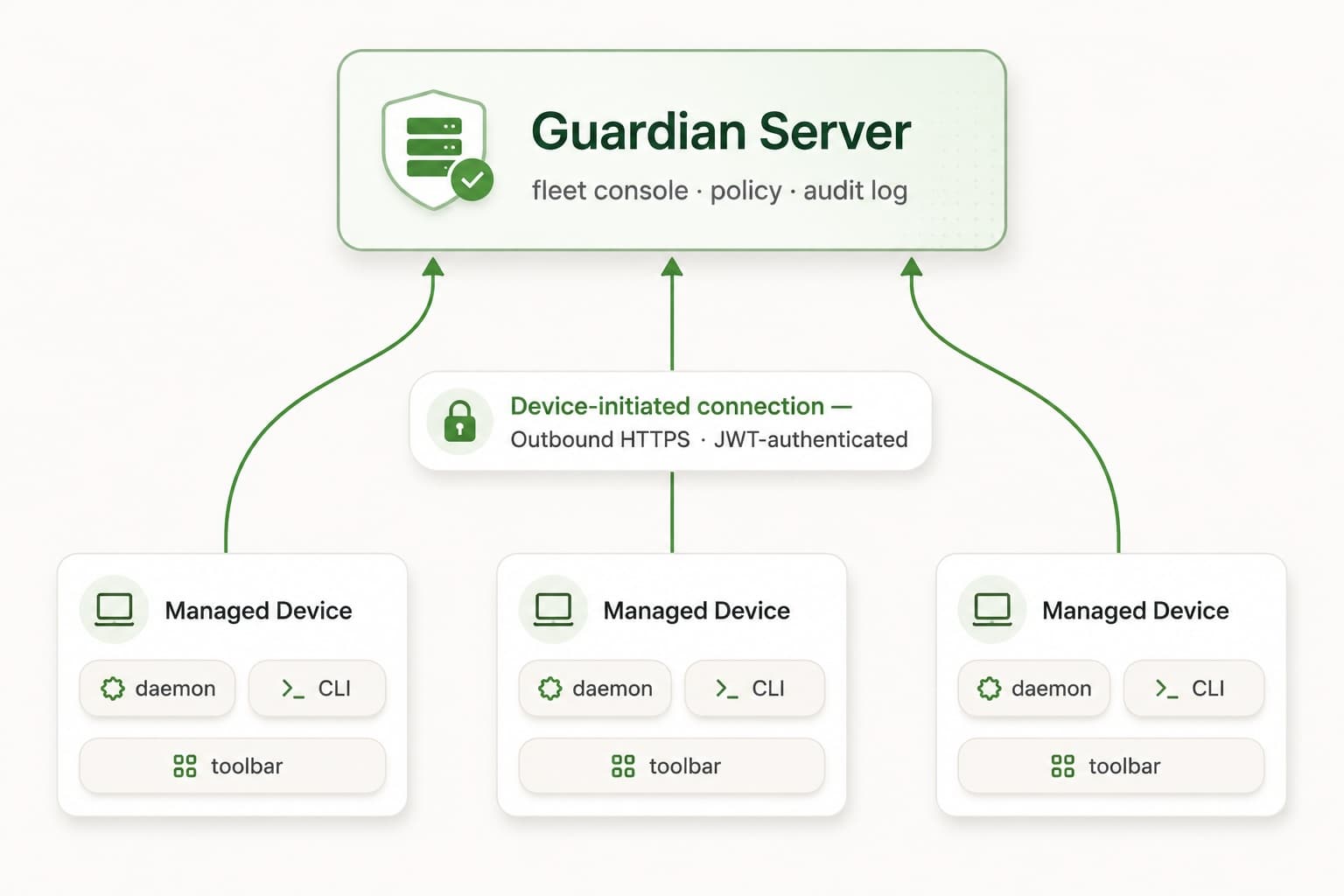
Guardian works inside the AI agent workflow through native hooks while giving you fleet-wide visibility. It's not a network proxy, a sandbox, or a secrets scanner. It's AI EDR: an inspection layer built specifically for coding agents.
Native hooks. No code changes, no proxy
Five enforcement modes: Block, Warn, Audit, Log, Allow
Monitor-first rollout: allows by default until you choose to block
Background daemon with offline resilience
SSO/OIDC/SAML integration
Guardian fleet architecture: a Guardian server with fleet console, policy, and audit log, connected to managed devices over device-initiated outbound HTTPS.Guardian on a single device: AI agents fire hooks that write records to a spool, the guardian-daemon ingests them and runs credential detection, policy engine, and session watching, then syncs to the server.
Live audit trail
policy · decision · provenance
14:32:07
Claude Code Pasted Anthropic API key into promptBlock
credential-in-prompt · sk-ant-•••
14:32:05
Cursor Read browser-stored GitHub tokenRedact
redact-on-read · ghp_••••a4x9
14:32:03
Aider Read ~/.aws/credentialsWarn
credential-file-access · AKIA••••MPLE
14:32:01
Claude Code Committed .env to gitBlock
secret-detected · DATABASE_URL
14:31:58
GitHub Copilot MCP tool: github.repo.deleteBlock
attack-path: prompt_injection · @org/payments

Built for teams that
answer to auditors.

Every time Guardian blocks, warns, or allows an action, it records exactly which policy rules were in effect. Your audit trail is complete and provable. Auditors love that.

SOC 2 Type II compliant
Complete audit trail for every agent action
Credential values never leave the machine, only one-way fingerprints
Policy versioning with per-decision provenance
Alert rules with PagerDuty, Slack, and SIEM integration
SSO/OIDC/SAML for enterprise identity

Get early access to Guardian

Guardian is in early preview. We're working with security teams who want to get ahead of AI agent risk. If that's you, let's talk.